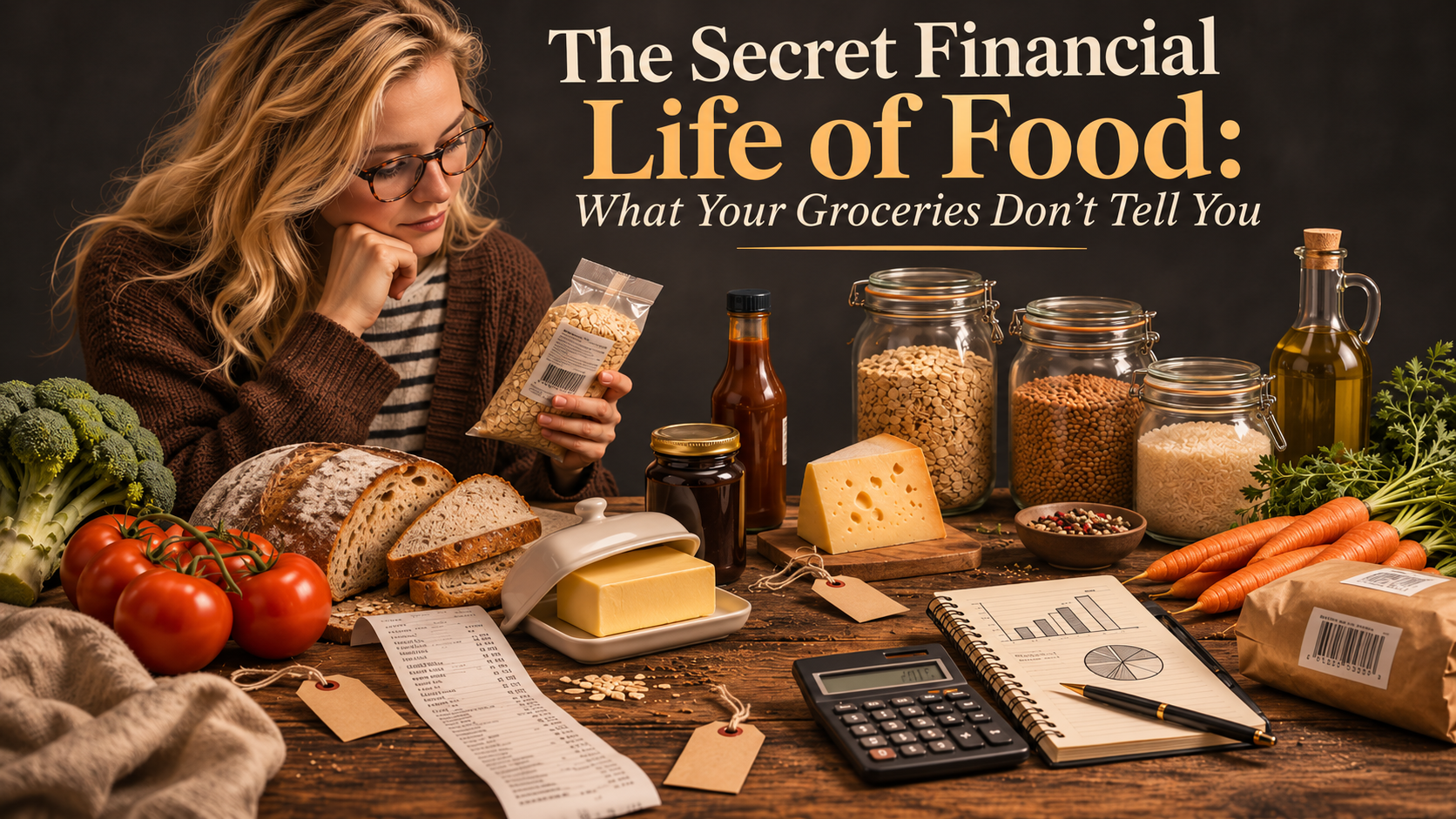
You pick up a jar of Marmite, a block of butter and a bottle of sauce. You check the prices, perhaps compare two brands, and move on. Nothing unusual about that.
But have you ever wondered why these products exist in the first place? Who decided what they should cost? Or how a food that began as a factory by-product ended up becoming a household favourite?
The secret financial life of food is full of surprising decisions, fierce competition and clever inventions. Some familiar products were created to solve practical problems. Others became successful because someone spotted a business opportunity.
Your weekly shop has quite a history behind it.
Why Does Everyday Food Have Such a Complicated Financial History?
Food has always been a business. Farmers grow ingredients, manufacturers turn them into products, and retailers sell them to customers. Each stage involves money, labour, equipment and decisions about what people are willing to pay.
As food production expanded, the business became increasingly complicated.
Manufacturers needed ways to produce more food without sacrificing consistency. They also needed products that could survive transportation, remain usable for longer and appeal to customers who had plenty of alternatives.
That created opportunities for inventors and entrepreneurs.
A new production method could make an expensive food more affordable. A successful brand could turn a simple recipe into a familiar supermarket staple. And a change in ownership could determine whether a product continued to be manufactured in its original home.
The stories behind butter, Marmite and HP Sauce show just how much business history can be found in an ordinary kitchen.
Butter vs Margarine: When Food Became Big Business
Today, butter and margarine sit alongside each other in supermarkets. Their rivalry, however, began long before modern grocery shopping.
In 1869, Napoleon III offered a prize for developing a cheaper alternative to butter. The aim was practical: find something suitable for the military and families who could not easily afford the real thing.
French chemist Hippolyte Mège-Mouriès developed oleomargarine, providing an answer to a problem involving food supply and affordability.
What happened afterwards was arguably just as interesting.
As margarine became more widely available, it began competing with established dairy businesses. Butter producers had a commercial reason to resist a cheaper rival, particularly one that could attract customers looking to save money.
In the United States, opposition from the dairy industry helped bring about the Margarine Act of 1886, which introduced taxes and licensing requirements.
A disagreement over what people spread on their bread had become a matter of legislation.
Margarine later gained popularity during the Second World War, when affordability and storage were especially important.
The lesson is simple: the economics of food can shape what people eat, which businesses succeed and even the rules governing a product.
How Marmite Turned a Brewing By-product into a Household Favourite
Marmite provides a completely different example of business ingenuity.
Its story begins with brewing, rather than bread or breakfast.
Breweries produced yeast sediment that had little commercial use. Instead of allowing that material to go to waste, manufacturers found a way to transform it into something people could eat.
Through a process involving the breakdown of yeast cells, followed by filtering, seasoning and concentration, a brewing by-product became the distinctive dark spread recognised today.
Think about the business opportunity involved.
A material that might otherwise have been discarded could now be processed, packaged, branded and sold.
Of course, creating something edible was only the beginning. Customers also needed a reason to buy it, enjoy it and keep returning for more.
Marmite eventually developed a strong identity built around its unmistakable taste. Its reputation became part of its commercial appeal.
The fascinating part is that the product’s origins were rooted in finding value where others might have seen waste.
It is a reminder that successful food businesses do not always begin with an entirely new ingredient. Sometimes they begin by discovering a better use for something already available.
The Business Decisions Behind Your Favourite Food Brands
A familiar label can make a product feel as though it has always belonged in the same place.
HP Sauce offers an interesting reminder that this is rarely guaranteed.
For decades, the sauce was manufactured in Birmingham, where its connection to British food culture became part of its history. Yet its recipe drew on ingredients with much wider origins, including tomatoes, molasses, dates, tamarind and spices.
The product was British in identity, but international in its ingredients.
Then came a major commercial decision.
Heinz moved HP Sauce production to the Netherlands, and the Birmingham factory closed in 2007. The decision caused considerable public backlash.
For the business, relocating production was a way to reduce costs. For people who associated the sauce with Birmingham, the change meant losing a long-standing local connection.
Both perspectives reveal something important about the financial life of food security.
Manufacturing decisions affect more than the price of a bottle. They can influence jobs, local communities and the relationship customers feel they have with a brand.
A product may keep its familiar appearance while the business behind it changes significantly.
Why Innovation Changes What We Eat
Sometimes the food industry develops new products because existing methods may struggle to meet future demand.
That concern helped inspire the development of Quorn.
During the 1960s, questions about future food supplies encouraged researchers to investigate alternative sources of protein. In Britain, research supported by Rank Hovis McDougall eventually led scientists to identify a fungus called Fusarium venenatum.
Through fermentation, it could be used to produce mycoprotein, the ingredient associated with Quorn products.
Marlow Foods was established in 1985, helping bring the innovation into the food market.
What makes this story interesting is the distance between the original research and the finished product.
Scientists had to identify a suitable organism and develop a practical production process. Businesses then needed to manufacture the resulting food consistently and persuade customers to try something unfamiliar.
That takes investment, technical knowledge and commercial confidence.
Quorn demonstrates how a concern about future food supplies can lead to research, new manufacturing methods and eventually a new category of supermarket products.
What Are We Really Paying for at the Supermarket?
When two products look similar but carry different prices, it is tempting to assume that the ingredients explain everything.
They rarely tell the whole story.
Consider what happens before a bottle, tub or packet reaches the shelf. Ingredients must be sourced. Equipment and workers are needed to manufacture the food. Packaging must protect it, and transportation must deliver it to shops.
Businesses must also account for product development, marketing and the cost of operating their facilities.
Brand recognition can influence what customers are prepared to pay, too. People often choose something familiar because they know its taste or trust its consistency.
None of this means a higher price automatically indicates a better product.
It means that supermarket prices emerge from a combination of production costs, business decisions, competition and customer preferences.
Understanding that gives us a more interesting way to look at everyday groceries.
Look Beyond the Food Barcode
The next time you reach for butter, Marmite or your favourite sauce, take another look at the label.
Behind it may be a story involving an inventor searching for a cheaper alternative, a manufacturer finding a use for discarded material or a company making a difficult decision about production.
These stories are explored in Paul Hesketh’s The Secret Life of Everyday Foods, which examines where familiar foods come from, how they are made and the unexpected histories that shaped them.
If you enjoy discovering the stories behind ordinary things, visit Paul Hesketh’s official website to learn more about the book.
Your shopping basket might never look quite the same again.