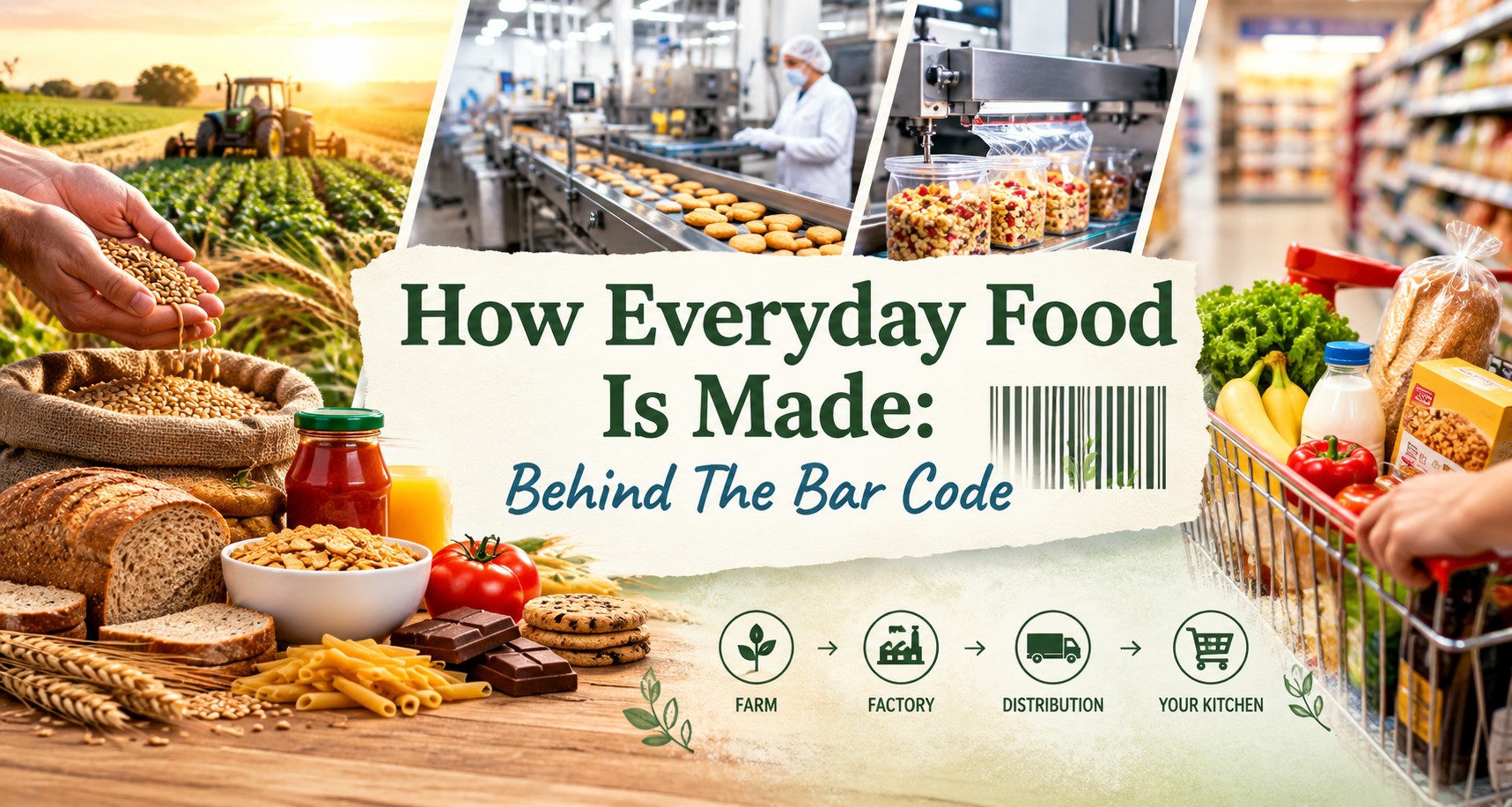
Walk through any supermarket and you will find shelves filled with foods that seem familiar: bread, cereals, pasta, chocolate, sauces, drinks, biscuits and many other everyday products. We buy them regularly, but how often do we stop to think about where they come from or how everyday food is made?
Food has a fascinating journey before it reaches our kitchens. Raw ingredients are grown, harvested, transported, processed, preserved, packaged and distributed. Along the way, science, technology, agriculture and human ingenuity all play an important role.
This is the world explored in Behind The Bar Code: The Secret Life of Everyday Foods by Paul Hesketh. The book takes readers beyond the packaging to discover the stories, processes and people connected to familiar foods.
What Happens Before Food Reaches the Supermarket?
When we pick up a product from a supermarket shelf, we usually see the finished item rather than the journey behind it. A loaf of bread, for example, begins with ingredients such as wheat, which must first be cultivated and harvested. The grain then goes through processing before becoming flour, which can eventually be transformed into bread.
The same principle applies to countless foods.
Understanding how ever czxyday food is made means looking at the stages between raw materials and the finished product. Depending on the food, these stages may include:
- Growing or sourcing raw ingredients
- Harvesting agricultural products
- Cleaning and preparing ingredients
- Processing and transforming raw materials
- Cooking, baking or other forms of preparation
- Preservation and storage
- Packaging and labelling
- Transportation and distribution
- Sale to consumers
Not every food follows exactly the same route. Fresh vegetables, canned products, cereals, sauces and confectionery all require different processes.
How Everyday Food Is Made: From Farm to Factory
Agriculture is one of the first links in the food supply chain. Farmers produce crops and livestock that provide many of the raw materials used by the food industry.
Grains such as wheat, maize and oats can be processed into ingredients used in bread, cereals, biscuits and other products. Fruits and vegetables may be cleaned, sorted, cut, preserved or packaged before reaching consumers.
Once agricultural products leave the farm, they can enter a much larger manufacturing and distribution system.
Food manufacturing uses different techniques depending on the desired result. Some processes are designed to change texture or appearance, while others help with preservation, preparation or convenience.
For example, ingredients may be milled, mixed, heated, cooled, dried, fermented or packaged. Modern machinery allows food manufacturers to carry out many of these operations efficiently and consistently.
This helps explain how everyday food is made on a much larger scale than would be possible in an ordinary household kitchen.
Why Food Manufacturing Is Important
Food manufacturing connects agriculture with consumers. It allows raw ingredients to be transformed into products that can be transported, stored and prepared in different ways.
Consider familiar supermarket products such as breakfast cereals, sauces or biscuits. They may contain ingredients sourced from different places and pass through several stages before reaching the shelf.
The manufacturing process can involve specialist equipment, quality checks, packaging systems and distribution networks. Behind one apparently simple product may be a surprisingly complex chain of people, machinery and decisions.
This connection between the farm, factory, retailer and consumer is an important part of understanding modern food.
The Science Behind Everyday Foods
Food manufacturing is not simply about putting ingredients together. Science plays a significant role in understanding what happens during processing.
Processes such as heating, cooling, fermentation, filtration and preservation can change the physical and chemical characteristics of food. Understanding these processes helps explain why foods behave differently during manufacturing, storage and cooking.
For young readers especially, this can make everyday products much more interesting.
A familiar bottle of sauce or packet of cereal suddenly becomes an example of science in action. Instead of seeing only the finished product, readers can start asking questions:
Where did the ingredients come from?
Why was the food processed in this particular way?
How is it preserved?
How does it reach the supermarket?
These questions reveal that ordinary food can have extraordinary stories behind it.
Behind The Bar Code by Paul Hesketh
Behind The Bar Code: The Secret Life of Everyday Foods by Paul Hesketh explores the hidden histories and processes behind familiar foods. Rather than treating food simply as something placed on a supermarket shelf, the book encourages readers to investigate the journey behind everyday products.
Paul Hesketh brings together his background in agriculture, business and food supply chains with his curiosity about the foods people consume every day. His career spans more than 45 years, and his agricultural experience includes managing a commercial herd of Charolais cattle and more than 500 ewes in Cheshire.
The book is particularly aimed at teenagers and young adults, while also offering plenty for curious parents and anyone interested in food history, science and production.
Readers can explore stories connected to products such as Weetabix, Paxo, Bisto, Vimto, Branston Pickle, HP Sauce, chocolate, coffee, bread and many other familiar foods.

What Makes Behind The Bar Code Different?
One of the interesting features of Behind The Bar Code is its focus on the stories behind ordinary products.
The book looks at invention, accidents, scientific discoveries, commercial competition and the people who helped transform raw ingredients into recognisable products.
It introduces readers to real historical figures and pioneers, including Louis Pasteur, Henry J. Heinz, John Lawson Johnston, Janet Keiller, Frank and Forrest Mars, and Frederick Gibson Garton.
There are no fictional characters driving the story. Instead, the book uses real people, food products and historical developments to explain how the modern food landscape developed.
This approach can make food education more engaging because readers can connect historical events and scientific ideas with products they already know.
Understanding How Everyday Food Is Made
Learning how everyday food is made can also change the way we look at supermarket shelves.
A packet of pasta is no longer simply pasta. It represents agricultural production, raw materials, manufacturing, packaging and distribution.
A chocolate bar can lead to questions about ingredients, manufacturing techniques, branding and commercial history.
A familiar condiment can reveal connections between agriculture, trade, innovation and changing consumer tastes.
This perspective encourages curiosity rather than simply accepting food as a finished product.
From Food History to Food Education
Food education is not limited to recipes or nutrition. It can also involve understanding where food comes from and how it reaches us.
For teenagers and young adults, learning about food production can provide an accessible introduction to subjects including science, agriculture, history, business and manufacturing.
For parents, it can also create opportunities for conversations about everyday products. A supermarket visit can become a chance to look at labels, identify ingredients and discuss the journey that food takes before reaching the kitchen.
Behind The Bar Code supports this broader approach by connecting everyday foods with the stories and processes behind them.
Why We Should Look Beyond the Packaging
Packaging tells us what a product is, but it cannot always tell us the complete story of how it came to exist.
Behind a barcode may be farmers producing raw materials, engineers designing machinery, scientists studying food processes, manufacturers developing products, workers operating production lines and businesses distributing goods around the world.
The barcode is therefore only the final visible part of a much longer journey.
That is the central curiosity encouraged by Behind The Bar Code: look beyond the finished product and ask what happened before it reached the shelf.
How Everyday Food Is Made: A Journey Worth Understanding
The journey of food from farm to supermarket involves many stages. Some foods have relatively simple supply chains, while others involve numerous ingredients and complex manufacturing operations.
Whatever the product, understanding how everyday food is made gives us a clearer picture of the relationship between agriculture, manufacturing and consumers.
It also reminds us that the food we see every day has been shaped by generations of innovation, experimentation and changing consumer habits.
From bread and cereals to chocolate, sauces and drinks, familiar products have stories worth exploring.
Conclusion
Food is one of the most familiar parts of everyday life, yet much of its journey remains hidden from consumers. Behind every supermarket product are ingredients, people, processes, technology and history.
Behind The Bar Code: The Secret Life of Everyday Foods by Paul Hesketh invites readers to explore that hidden world. By examining the origins, science and manufacturing of familiar foods, the book helps connect everyday products with the wider stories behind them.
For anyone curious about how everyday food is made, looking beyond the barcode can reveal just how much history and human ingenuity can be found in an ordinary kitchen cupboard.